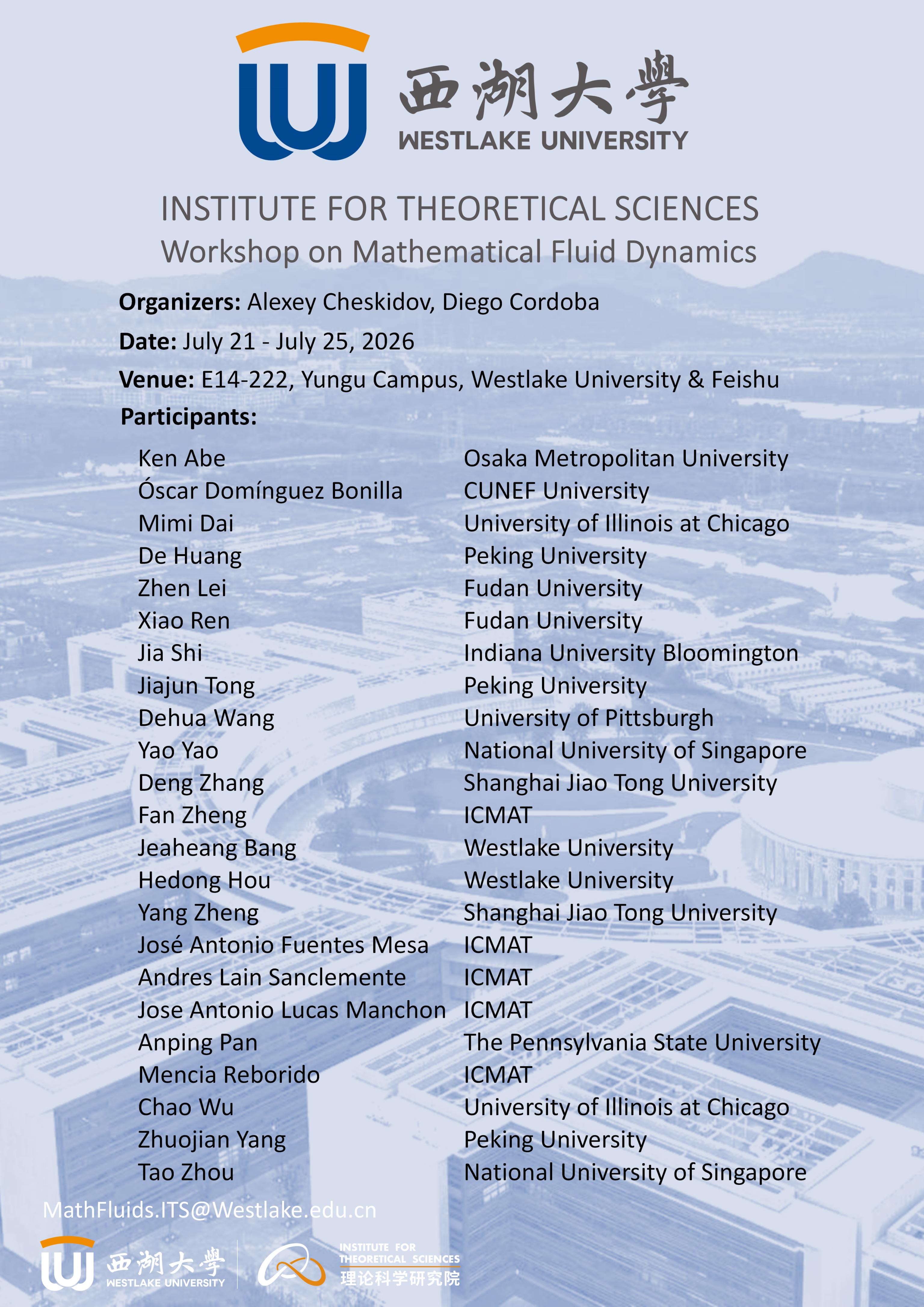
Date: July 21 - July 25, 2026
Venue: E14-222, Yungu Campus & Feishu
Ⅰ Agenda
| DATE |
VENUE |
TIME |
Title |
SPEAKER |
AFFILIATION |
| July 21 |
E14-222 Yungu Campus |
12:30-13:30 |
Recent results on (stochastic) Navier-Stokes equations: continuous energy solutions and Lagrangian chaos |
Deng Zhang |
Shanghai Jiao Tong University |
| 13:30-14:30 |
How a Strong Magnetic Field Stabilizes Large MHD Perturbations: The Case of Unequal Viscosity and Resistivity |
Xiao Ren |
Fudan University |
| 14:30-15:30 |
Stability of Lamb dipoles without finite mass condition |
Ken Abe |
Osaka Metropolitan University |
| 15:30-16:30 |
Boundary Layer Theory |
Zhen Lei |
Fudan University |
| 17:00 |
Dinner |
| July 22 |
E14-222 Yungu Campus |
9:00-10:00 |
Vortex sheets and boundary layers in elastic fluids |
Dehua Wang |
University of Pittsburgh |
| 10:00-11:00 |
Energy cascade in fluid equations |
Mimi Dai |
University of Illinois at Chicago |
| 11:00-12:00 |
Existence of Sadovskii vortex patch via a fixed-point approach |
De Huang |
Peking University |
| 12:00-13:00 |
Lunch |
| 13:00-14:00 |
Rotating vortex patches with 90-degree corners for the 2-D incompressible Euler equation |
Jiajun Tong |
Peking University |
| 14:00-15:00 |
Sharp Ill-Posedness of the Euler Equations in Lorentz Spaces |
Jeaheang Bang |
Westlake University |
| 15:00-16:00 |
Non-uniqueness of mild solutions and stationary singular solutions to the Navier-Stokes equations |
Hedong Hou |
Westlake University |
| 16:30-17:30 |
Dinner |
| July 23 |
Feishu |
9:00-10:00 |
TBA |
Óscar Domínguez Bonilla |
CUNEF Universidad |
| 10:00-11:00 |
Constructing finite time singularities for some nonlinear PDEs |
Jia Shi |
Indiana University Bloomington |
| 11:00-12:00 |
Infinite-in-time growth in 2D and 3D Euler equations |
Yao Yao |
National University of Singapore |
| 12:00-13:00 |
Lunch |
| 13:00-17:00 |
Student/Postdoc Talks |
| July 24 |
Feishu |
9:00-10:00 |
Low-regularity method in fluid models |
Xinyu Cheng |
Fudan University |
| 10:00-11:00 |
Controllability of incompressible fluids: open problems and recent progress |
Manuel Rissel |
Shanghai Tech University |
| 11:00-12:00 |
The applications of dissipation enhancing flows to Cahn-Hilliard Equation |
Yuanyuan Feng |
East China Normal University |
| 12:00-13:00 |
Lunch |
| 13:00-14:00 |
Self-Organization in Turbulence: How Order Emerges from Disorder |
Guangyu Ding |
Fudan University |
| 14:00-15:00 |
Stability of damped wave equations |
Runzhang Xu |
Harbin Engineering University |
| 15:00-16:00 |
A new flow dynamic approach for Wasserstein gradient flows |
Qing Cheng |
Tongji University |
| 16:00-17:00 |
Periodic Solutions to Evolution Equations: Theory and Applications to Fluid Dynamics |
Nguyen Thieu Huy |
Hanoi University of Science and Technology |
| July 25 |
Feishu |
9:00-10:00 |
Anisotropic stability of 3D compressible Navier-Stokes equations with eddy Diffusion |
Zefu Feng |
Chongqing Normal Unviversity |
| 10:00-11:00 |
Global well-posedness of semi-self-similar solutions to the two-dimensional Prandtl equation near stagnation point |
Tao Tao |
Shandong University |
| 11:00-12:00 |
TBA |
Dao Nguyen Anh |
Ho Chi Minh University of Economics |
Ⅱ Abstracts
Talks at Westlake
Speaker: Deng Zhang, Shanghai Jiao Tong University
Title: Recent results on (stochastic) Navier-Stokes equations: continuous energy solutions and Lagrangian chaos
Abstract: In this talk we will show some recent results on (stochastic) Navier-Stokes equations. More precisely, we will first show that, for arbitrarily prescribed finite energy divergence-free initial data, there exist infinitely many global-in-time weak solutions with continuous energy profiles to both the 3D deterministic and stochastic Navier-Stokes equations. For the critical initial data, we also prove the existence of infinitely many dissipative solutions to the 3D Navier-Stokes and MHD equations.
Furthermore, we consider the Lagrangian flow associated with the 2D Navier–Stokes equations, where the random force is bounded and is highly degenerate, acting only a small number of Fourier modes. We show that the Lagrangian flow exhibits chaotic behavior characterized by the strict positivity of the top Lyapunov exponent.
Speaker: Xiao Ren, Fudan University
Title: How a Strong Magnetic Field Stabilizes Large MHD Perturbations: The Case of Unequal Viscosity and Resistivity
Abstract: A strong background magnetic field is expected to weaken nonlinear interactions in MHD, although the associated large linear term produces no direct energy dissipation. When viscosity and resistivity are unequal, diffusion couples the two counter-propagating Alfvén wave families. We show that the strong null structure of the nonlinear interaction remains effective under this coupling, yielding global solutions for large perturbations when the background field is sufficiently strong. The proof involves a div–curl bilinear estimate and oscillatory-integral analysis of the coupled linear dynamics. This is joint work with Fei Jiang and Yi Zhou.
Speaker: Ken Abe, Osaka Metropolitan University
Title: Stability of Lamb dipoles without finite mass condition
Abstract: I will discuss stability of Lamb dipole solution in the 2D Euler equations based on joint works with Kyudong Choi (UNIST), In-Jee Jeong (KIAS), and Yao Yao (NUS).
Speaker: Zhen Lei, Fudan University
Title: Boundary Layer Theory
Abstract: The Prandtl equation is fundamental in boundary layer theory. In this talk we present recent progress on global regularity of unsteady equation and sharp asymptotic stability of steady equation. Based on joint work with Prof. Hao Jia (Univerisity of Minnesota) and Dr. Cheng Yuan (Fudan University).
Speaker: Dehua Wang, University of Pittsburgh
Title: Vortex sheets and boundary layers in elastic fluids
Abstract: Elasticity is important in continuum mechanics with a wide range of applications and is challenging in analysis. In this talk we shall first review some basic mathematical results and then discuss some special elastic effects in elastic fluids. The first elastic effect is the stabilizing effect of elasticity on the vortex sheets in compressible elastic flows. Some recent results on linear and nonlinear stability of compressible vortex sheets will be presented. The second effect is on the vanishing viscosity process of compressible viscoelastic flows in the half space under the no-slip boundary condition. Our results show that the deformation tensor can prevent the formation of strong boundary layers.
Speaker: Mimi Dai, University of Illinois at Chicago
Title: Energy cascade in fluid equations
Abstract: We will discuss energy cascade in fluid equations and exploiting it in constructions to lead non-uniqueness and blowup.
Speaker: De Huang, Peking University
Title: Existence of Sadovskii vortex patch via a fixed-point approach
Abstract: The Sadovskii vortex patch—a steady contiguous anti-symmetric vortex-patch dipole solution of the 2D incompressible Euler equation—was numerically discovered over 50 years ago, whose was also observed as an accurate approximation of the large-time asymptotic profile in the head-on collision of two anti-symmetric vortex rings. In this talk, we present the first proof of existence of the Sadovskii vortex patch with 90-degree touching angles via a fixed-point approach. In particular, we show that the upper boundary of the Sadovskii vortex patch is given by a smooth even function that is monotonic on one side. This is based on a joint work with Jiajun Tong.
Speaker: Jiajun Tong, Peking University
Title: Rotating vortex patches with 90-degree corners for the 2-D incompressible Euler equation
Abstract: We will discuss recent progress on constructing uniformly rotating vortex patches with 90-degree corners for the 2-D incompressible Euler equation. This is based on a joint work with De Huang and Xiaopeng Zheng.
Speaker: Jeaheang Bang, Westlake University
Title: Sharp Ill-Posedness of the Euler Equations in Lorentz Spaces
Abstract: We are concerned about vortex stretching for the three-dimensional axisymmetric Euler equations without swirl in vorticity formulation. Danchin (2007) established global existence and uniqueness for bounded vorticity $\omega_0$ provided the relative vorticity $\omega_0/r$ lies in the endpoint Lorentz space $L^{3,1}(\mathbb{R}^3)$ (together with a decay assumption on $\omega_0$). We proved that this $L^{3,1}$ endpoint is sharp: for every Lorentz exponent $q>1$, we construct multi-ring data $\omega_0 \in L^\infty (\mathbb{R}^3)$ with $\omega_0/r\in L^{3,q}(\mathbb{R}^3)$ that produce $L^\infty$-norm inflation of the vorticity; moreover, within the same class, we also obtain instantaneous blow-up from data with infinitely many rings.
Our initial data are inspired by the Kim--Jeong dyadic ring superposition (2022) and also by Cordoba--Martinez-Zoroa--Zheng (2025), but we crucially generalize it by allowing flexible conical support geometry for the ring profile. In the regime where outer rings are dominant---a multiscale viewpoint appearing in recent works including Kim--Jeong (2022) and Cordoba--Martinez-Zoroa--Zheng (2025)---we obtain a forward-in-time ODE cascade for ring amplitudes and aspect ratios in which vortex stretching weakens its own future forcing: as a ring amplifies, incompressibility flattens it, the aspect ratio collapses, and the induced stretching coefficient is geometrically depleted. A key new ingredient is a profile-localization argument that freezes the relevant Biot–Savart kernel and makes this depletion explicit, enabling us to exploit a monotone ``productive window" (controlled by the cone slope) together with an exact cascade identity. This propagates stretching across scales and gives a robust lower bound on cumulative stretching, yielding ill-posedness in the full range $q>1$.
This is a joint work with Alexey Cheskidov (Westlake University).
Speaker: Hedong Hou, Westlake University
Title: Non-uniqueness of mild solutions and stationary singular solutions to the Navier-Stokes equations
Abstract: In this talk, I will present that the unconditional uniqueness of mild solutions to the Navier-Stokes equations fails in all the Besov spaces with negative regularity index, by constructing non-trivial stationary singular solutions via convex integration. To the best of our knowledge, this is the first non-uniqueness result in subcritical solution classes. Similar results also hold for the fractional Navier-Stokes equations with arbitrarily large power of the Laplacian, even in certain subcritical Lebesgue spaces. This talk is based on a joint work with Alexey Cheskidov.
Talks at Feishu
Speaker: Óscar Domínguez Bonilla, CUNEF Universidad
Title: TBA
Abstract: TBA
Speaker: Jia Shi, Indiana University Bloomington
Title: Constructing finite time singularities for some nonlinear PDEs
Abstract: In this talk, I will introduce the implosion blow-up results for the compressible Euler, the compressible Navier-Stokes equations, and the defocusing nonlinear Schrödinger equation. We will discuss the existence of self-similar solutions and the stability near those solutions. During the talk, I will mention our work with Gonzalo Cao-Labora, Javier Gómez-Serrano, and Gigliola Staffilani on the first non-radial implosion result for those three equations. If there is time, I will also mention our work on self-similar solutions of a hydrodynamic equation that may formally arise as potential blow-up profiles of the focusing NLS equation.
Speaker: Yao Yao, National University of Singapore
Title: Infinite-in-time growth in 2D and 3D Euler equations
Abstract: In this talk, I will discuss two results on infinite-in-time growth in 2D and 3D incompressible Euler equations. For the 2D Euler equation on the whole plane, we construct the first example giving superlinear growth of the vorticity gradient for smooth compactly supported vorticity (joint with In-Jee Jeong and Tao Zhou). For the 3D axisymmetric Euler equation without swirl, we establish some upper and lower bound for the radial moment of vorticity, and prove that under some sign and symmetry conditions, all solutions must have their vorticity L^p norm growing to infinity with some power-law rate for all p>=1. To the best of our knowledge, this is the first result to establish power-law L^p-norm growth for smooth, compactly supported initial vorticity in R^3. (joint with Khakim Egamberganov).
Speaker: Xinyu Cheng, Fudan University
Title: Low-regularity method in fluid models
Abstract: Among the study of fluid PDEs, solutions with low regularity play an important role in the study of fluid PDEs and are deeply connected to the well-known Onsager conjecture. Moreover, computing low-regularity solutions needs to be uniform in viscosity, since smoothing effect is effective when t>1/nu. In this talk, we will discuss some recent progress in parameter-stable methods for low-regularity problems arising from fluid models, supported by both analytical and numerical results.
Speaker: Manuel Rissel, Shanghai Tech University
Title: Controllability of incompressible fluids: open problems and recent progress
Abstract: One question in controllability theory is to determine the states between which a system can be steered within a prescribed time via suitable control inputs (e.g., localized forces). In this talk, I will discuss global controllability of incompressible fluids in any positive time. Here, global means that there is no smallness constraint on the admissible initial and target states. A famous open problem in this category was posed by J.-L. Lions and concerns approximate controllability of the Navier–Stokes equations under no-slip boundary conditions driven by a localized force. Another well-known open problem was formulated by A. A. Agrachev and asks whether approximate controllability of the Navier–Stokes system (e.g., under periodic boundary conditions) can be achieved by a localized force that belongs at each time to a fixed universal finite-dimensional space independent of the state and viscosity. Both of these controllability questions are connected to the subject of turbulence and to other prominent topics in mathematical fluid dynamics. I will also discuss other related problems and present recent progress in these directions.
Speaker: Yuanyuan Feng, East China Normal University
Title: The applications of dissipation enhancing flows to Cahn-Hilliard Equation
Abstract: In this talk, we would study how stirring would help dissipate the energy and the applications to Cahn-Hilliard equations. For the advective Cahn-Hilliard equation, the phase separation would be suppressed when the amplitude of the advective mixing flow is large. If the shear flow is added, at sufficiently large times and when the strength of the shear is strong enough, the isotropic patterns typical of the 2D CHE are distorted into elongated patterns along the direction of the shear and ultimately banded patterns appear.
Speaker: Guangyu Ding, Fudan University
Title: Self-Organization in Turbulence: How Order Emerges from Disorder
Abstract: Turbulence is often regarded as the archetype of disorder, yet many turbulent flows spontaneously generate remarkably organized structures. Examples range from atmospheric vortices and oceanic jets to large-scale circulations in laboratory experiments. Understanding how such coherent structures emerge from seemingly chaotic motions remains a central challenge in fluid dynamics and nonlinear science. In this lecture, I will discuss recent results on quasi-two-dimensional turbulence, a class of flows in which energy is transferred from small scales to large scales through the inverse cascade. Using direct numerical simulations, we investigate how large-scale vortices arise, interact with turbulent fluctuations, and modify the energy transfer across scales. Particular attention will be paid to the role of scale interactions, the emergence of scale-invariant structures, and the limitations of classical turbulence theories based on local cascade arguments. These results reveal how coherent organization can emerge from strongly turbulent motions and provide new perspectives on the formation of large-scale structures in geophysical and astrophysical flows. Beyond fluid mechanics, these findings raise broader questions about how local interactions generate organization across scales, a theme that appears repeatedly in geophysical, astrophysical, and many other multiscale systems.
Speaker: Runzhang Xu, Harbin Engineering University
Title: Stability of damped wave equations
Abstract: In this talk, we are concerned with the description of global quantitative stability of wave equations with linear strong damping and linear or nonlinear weak damping. By giving some energy decay estimates, we obtain several conclusions about the continuous dependence of the global solution on the initial data and the coefficients of the strong damping term and linear or nonlinear weak damping term. This work also establishes a new idea to use the dissipative effect to obtain the better continuous dependence conclusions, which also reflect the dissipative properties of the solution. This is a collaborated work with Dr. Jiangbo Han at Harbin Engineering University/Inner Mongolia University, Dr. Chao Yang at AGH University of Science and Technology, Poland, and Professor Keyan Wang at Shanghai University of Finance and Economics.
Speaker: Qing Cheng, Tongji University
Title: A new flow dynamic approach for Wasserstein gradient flows
Abstract: We develop a new flow dynamic approach for Wasserstein gradient flows. Motivatied by the classic JKO scheme, we develop a new class of Lagrangian schemes which only need to solve minimization problems with respective to displacement instead of density and velocity. The new approach can effectively capture the movement of the trajectory of meshes, and also can automatically preserve the nice properties of Wasserstein gradient flow structure, for example,positivity-preserving, mass conserving and energy dissipation.Numerical experiments are shown in 1D and 2D for Keller-Segel equations,Focker-Plancker equations, Porous medium equations.
Speaker: Nguyen Thieu Huy, Hanoi University of Science and Technology
Title: Periodic Solutions to Evolution Equations: Theory and Applications to Fluid Dynamics
Abstract: We present some of our recent results on the periodicity, and stability theory of solutions to evolution equations in interpolation spaces.
Particular emphasis is placed on the role of interpolation techniques in combination with Massera and Serin's principles in establishing existence, uniqueness, and stability of time-periodic solutions. We discuss a unified functional-analytic framework that allows one to treat a broad class of nonlinear evolution problems arising in mathematical physics.
Speaker: Zefu Feng, Chongqing Normal Unviversity
Title: Anisotropic stability of 3D compressible Navier-Stokes equations with eddy Diffusion
Abstract: We investigate the Cauchy problem for the three-dimensional compressible Navier-Stokes equations with eddy diffusion, an anisotropic viscous mechanism arising naturally in geophysical fluid dynamics (cf. \cite{Jabin-Bresch-2018, Temam-Ziane-2004}). In contrast to the classical compressible Navier-Stokes system, the velocity equation contains no full vertical Laplacian; the vertical regularization available to the velocity is only partially encoded through the compressible mode $\mathrm{div}\,\mathbf{u}$. This degeneracy prevents the use of standard parabolic energy methods and of the usual high-low frequency Green-function bounds. We prove that the constant non-vacuum equilibrium $(\bar\rho,0)$ is globally nonlinearly stable for small Sobolev perturbations. More precisely, global classical solutions are constructed in $H^N(\mathbb{R}^3)$, $N\geq 3$, and the density and velocity are shown to converge to equilibrium with explicit anisotropic decay rates. The density and the compressible part of the velocity exhibit a hidden dissipative mechanism generated by the coupling between $\nabla\rho$ and $\mathrm{div}\,\mathbf{u}$, while the solenoidal part of the velocity behaves like a two-dimensional heat flow driven only by the horizontal eddy diffusion. The proof combines a refined anisotropic spectral decomposition of the Green matrix, div-curl analysis, and time-weighted nonlinear energy estimates tailored to the degenerate dissipation. To our knowledge, this provides the first global stability and large-time behavior result for the three-dimensional compressible Navier-Stokes equations with eddy diffusion in the whole space.
Speaker: Tao Tao, Shandong University
Title: Global well-posedness of semi-self-similar solutions to the two-dimensional Prandtl equation near stagnation point
Abstract: Sun (Physics of Fluids, 2024) derived a class of semi-self-similar equations for the two-dimensional Prandtl equation. In this talk, we discuss the global existence and stability of semi-self-similar solutions to the two-dimensional Prandtl equation describing flows near a stagnation point. First, by employing the maximum principle and the Crocco transformation, we establish the global existence and long-time behavior of the semi-self-similar solutions for some class of initial data. In particular, we prove the strong convexity of these solutions when time is sufficiently large. Then, using the maximum principle and the bootstrap method, we demonstrate the stability of the semi-self-similar solutions.
Speaker: Dao Nguyen Anh, Ho Chi Minh University of Economics
Title: TBA
Abstract: TBA