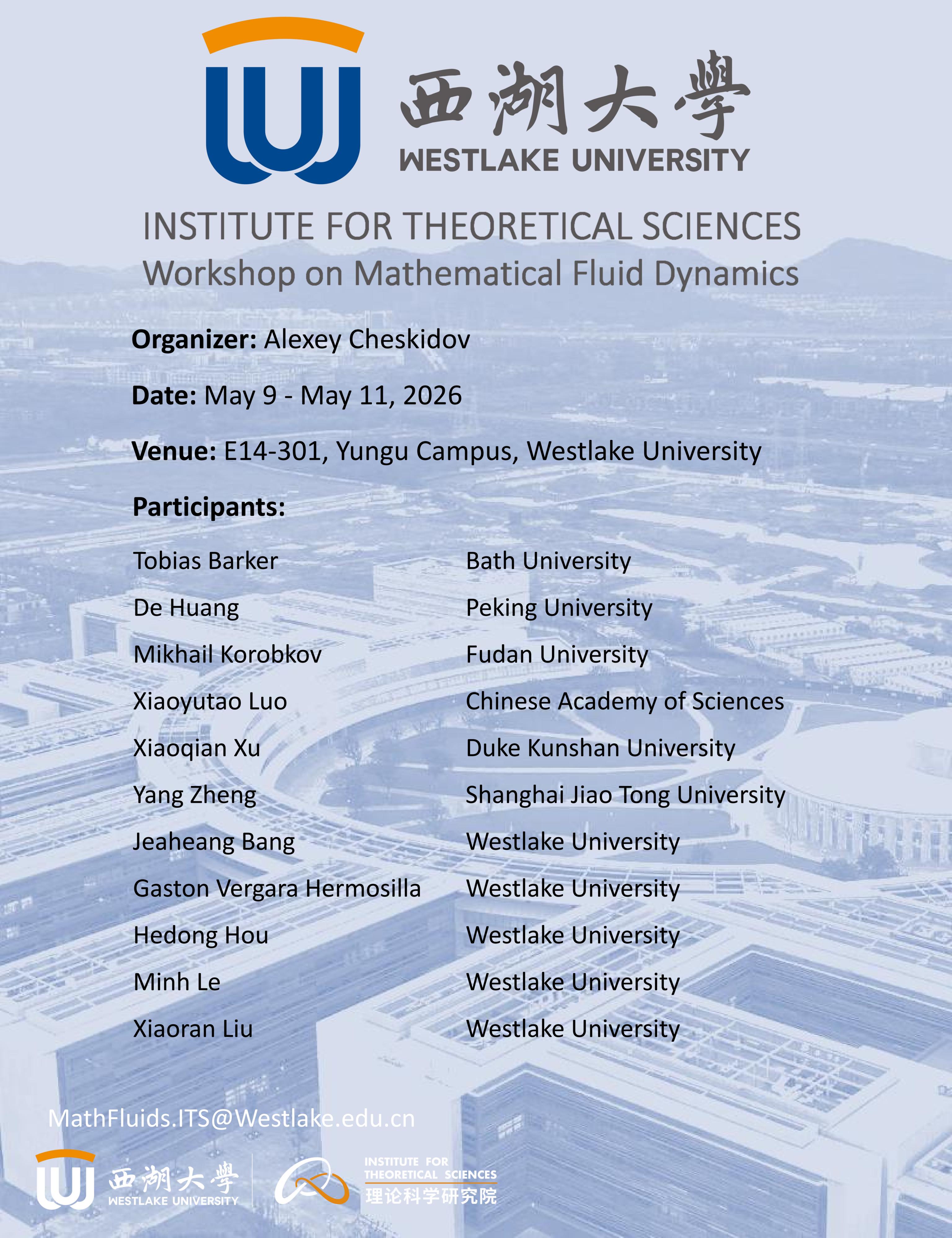
Date: May 9 - May 11, 2026
Venue: E14-301, Yungu Campus
Ⅰ Agenda
| Date |
Time |
Venue |
Title |
Speaker |
| 5.9 |
9:00-10:00 |
E14-301 |
Mixing flows and advection-diffusion equations |
Xiaoqian Xu |
| 10:00-11:00 |
Sharp ill-posedness of the Euler equations in a Lorentz space |
Jeaheang Bang |
| 11:00-12:00 |
Non-uniqueness of mild solutions and stationary singular solutions to the Navier-Stokes equations |
Hedong Hou |
12:00-14:00
|
Lunch |
| 14:00-15:00 |
Long-time dynamics near shear flows in the 2D Euler equations |
Xiaoyutao Luo |
| 15:00-16:00 |
Non-uniqueness of the advection-diffusion equation via instantaneous blow-up |
Xiaoran Liu |
| 16:00-17:00 |
Global boundedness, absorbing sets and mass persistence in two-dimensional chemotaxis–Navier–Stokes systems with weakly singular sensitivity and a sub-logistic source |
Minh Le |
| 17:30 |
Dinner
|
| 5.10 |
9:00-10:00 |
E14-301 |
Quantitative classification of potential Navier-Stokes singularities beyond the blow-up time |
Tobias Barker |
| 10:00-11:00 |
Novel self-similar finite-time singularity formation of two 1D models of the Euler equations |
De Huang |
| 11:00-12:00 |
The steady Navier-Stokes equations in a system of unbounded channels with sources and sinks |
Mikhail Korobkov
|
12:00-14:00
|
Lunch |
| 14:00-17:00 |
Discussion |
| 17:30 |
Dinner |
5.11
|
9:00-10:00 |
E14-301
|
Non-uniqueness of Leray-Hopf Solutions to Forced Stochastic Hyperdissipative Navier-Stokes Equations |
Yang Zheng |
| 10:00-11:00 |
TBA |
TBA |
| 11:00-12:00 |
TBA |
TBA |
| 12:00-14:00 |
Lunch |
| 14:00-17:00 |
Discussion |
| 17:30 |
Dinner |
Ⅱ Talks
May 9, Saturday
9:00-10:00
Speaker: Xiaoqian Xu, Duke Kunshan University
Title: Mixing flows and advection-diffusion equations
Abstract: In the study of incompressible fluid, one fundamental phenomenon that arises in a wide variety of applications is dissipation enhancement by so-called mixing flow. In this talk, I will give a brief introduction to the idea of mixing flow and examples of such flows. In addition, I will also discuss the un-mixing property of the diffusion process.
10:00-11:00
Speaker: Jeaheang Bang, Westlake University
Title: Sharp ill-posedness of the Euler equations in a Lorentz space
Abstract: We investigate vortex stretching in the 3D axisymmetric Euler equations without swirl to determine the sharpness of Danchin’s (2007) endpoint condition; Danchin’s result established global existence and uniqueness for bounded vorticity $\omega_0$ when $\omega_0/r \in L^{3,1}(\mathbb{R}^3)$ (together with a decay condition of $\omega_0$). We prove this $L^{3,1}$ endpoint is sharp. By constructing specialized multi-ring initial data where $\omega_0 \in L^\infty(\mathbb{R}^3)$ and $\omega_0/r \in L^{3,q}(\mathbb{R}^3)$ for any Lorentz second exponent $q > 1$, we established norm inflation. Furthermore, extending this construction to data with infinitely many rings within the same $L^{3,q}$ class results in instantaneous blow-up of solutions $\omega\in L^\infty(0,T;L^1\cap L^\infty (\mathbb{R}^3))$. This is a joint work with Alexey Cheskidov.
11:00-12:00
Speaker: Hedong Hou, Westlake University
Title: Non-uniqueness of mild solutions and stationary singular solutions to the Navier-Stokes equations
Abstract: In this talk, I will present that the unconditional uniqueness of mild solutions to the Navier-Stokes equations fails in all the Besov spaces with negative regularity index, by constructing non-trivial stationary singular solutions via convex integration. To the best of our knowledge, this is the first non-uniqueness result in subcritical solution class. Similar results also hold for the fractional Navier-Stokes equations with arbitrarily large power of the Laplacian, even in certain subcritical Lebesgue spaces. This talk is based on a joint work with Alexey Cheskidov.
14:00-15:00
Speaker: Xiaoyutao Luo, Chinese Academy of Sciences
Title: Long-time dynamics near shear flows in the 2D Euler equations
Abstract: In this talk, I will report on recent results concerning the long-time dynamics of shear flows in the 2D Euler equations. The results demonstrate how stability depends on domain geometry and perturbation regularity—ranging from inviscid damping in Sobolev spaces to asymptotic stability for Yudovich perturbations.
15:00-16:00
Speaker: Xiaoran Liu, Westlake University
Title: Non-uniqueness of the advection-diffusion equation via instantaneous blow-up
Abstract: Moerschell and Sorella have proved the sharp non-uniqueness of weak solutions for the vector field in L^p L^\infty for any fixed p<2. In this talk, I will present another proof for the non-uniqueness via instantaneous blow-up. The regularity of both solution and vector field are nearly sharp.
16:00-17:00
Speaker: Minh Le, Westlake University
Title: Global boundedness, absorbing sets and mass persistence in two-dimensional chemotaxis–Navier–Stokes systems with weakly singular sensitivity and a sub-logistic source
Abstract: In this talk, we consider a chemotaxis–fluid system modeling the interaction of a biological population with a chemical signal and a surrounding fluid. The system is studied in a two-dimensional bounded domain $\Omega$ and takes the form
\begin{equation*}
\begin{cases}
n_t + u \cdot \nabla n = \Delta n - \chi \nabla \cdot \left (n \frac{\nabla c}{c^k} \right ) + r n - \frac{\mu n^2}{\log^\eta(n+e)}, \\[4pt]
c_t + u \cdot \nabla c = \Delta c - \alpha c + \beta n, \\[4pt]
u_t + u \cdot \nabla u = \Delta u - \nabla P + n \nabla \phi + f, \\[4pt]
\nabla \cdot u = 0,
\end{cases}
\end{equation*}
where $r$, $\mu$, $\alpha$, $\beta$, $\chi$ are positive parameters, $k, \eta \in (0,1)$, $\phi \in W^{2,\infty}(\Omega)$, and $f \in C^1(\bar{\Omega}\times [0, \infty)) \cap L^\infty(\Omega \times (0, \infty))$.
The primary goal of this talk is to establish the global existence of bounded classical solutions to this system under appropriate assumptions on the initial data. We impose no-flux boundary conditions for both the cell density $n$ and the chemical concentration $c$, together with a Dirichlet condition for the fluid velocity $u$. Our main results are threefold. First, we prove that the system admits a globally bounded classical solution. Second, we demonstrate the existence of an absorbing set with respect to the topology of $C^0(\bar{\Omega}) \times W^{1,\infty}(\Omega) \times C^0(\bar{\Omega}; \mathbb{R}^2)$, which captures the long-term dissipative dynamics of the system. Third, we establish the persistence of the total mass of solutions, showing that the population does not go extinct in the long run. These findings provide insight into the interplay between chemotactic aggregation with singular sensitivity, logistic-type growth with a logarithmic correction, and fluid transport.
May 10, Sunday
9:00-10:00
Speaker: Tobias Barker, Bath University
Title: Quantitative classification of potential Navier-Stokes singularities beyond the blow-up time
Abstract: It remains an open problem whether or not solutions to the 3D Navier-Stokes equations with smooth data remain smooth for all time. All previously known regularity criteria are formulated in times of a blow-up time (where the solution loses smoothness), which make it practically impossible to use such necessary conditions to test the viability of certain numerically computed candidates. Motivated by these issues, we give the first quantitative classification of potentially singular solutions at any given time in the region of potential blow-up times. The quantitative lower bounds prior to any potential blow-up time (and in the open vicinity of it) are in principle amenable to numerical testing.
10:00-11:00
Speaker: De Huang, Peking University
Title: Novel self-similar finite-time singularity formation of two 1D models of the Euler equations
Abstract: It remains an open problem whether the 3D incompressible Euler equations can develop finite-time singularity from smooth initial data in the whole space. Nevertheless, self-similar finite-time blowups have been discovered and established for many models of the Euler equations. In this talk, I will introduce novel self-similar blowup phenomena of two 1D models, the generalized Constantin-Lax-Majda model and the Hou-Luo model. Both model can develop novel self-similar finite-time blowups with singular self-similar profiles, yet with distinct features. The novel blowup of the gCLM model exhibits a two-scale feature, while the novel blowup of the Hou-Luo model consists of two stages of blowups.
11:00-12:00
Speaker: Mikhail Korobkov, Fudan University
Title: The steady Navier-Stokes equations in a system of unbounded channels with sources and sinks
Abstract: The talk is based on our recent works with Giovanni P. Galdi, Filippo Gazzola, Xiao Ren, and Gianmarco Sperone, see
https://doi.org/10.48550/arXiv.2505.14642
https://doi.org/10.48550/arXiv.2602.16460
The steady motion of a viscous incompressible fluid in a junction of unbounded channels with sources and sinks is modeled through the Navier-Stokes equations under inhomogeneous Dirichlet boundary conditions. In contrast to many previous works, the domain is not assumed to be simply-connected, and the fluxes are not assumed to be small. In this very general setting, we prove the existence of a solution with a uniformly bounded Dirichlet integral in every compact subset. This is a generalization of the classical Ladyzhenskaya-Solonnikov result obtained under the additional assumption of zero boundary conditions. For small data of the problem, we also prove the unique solvability and attainability of Couette-Poiseuille flows at infinity. The main novelty of our approach is the proof of the corresponding Leray-Hopf-type inequality by Leray's reductio ad absurdum argument (since the standard Hopf cut-off extension procedure does not work for general boundary data). For this contradiction approach, we use some fine properties of weak solutions to the Euler system based on Morse-Sard-type theorems in Sobolev spaces obtained by Bourgain, Korobkov & Kristensen.
In the second part of the talk, we establish the uniqueness and structural stability of a class of parallel flows in a 2D straight, infinite channel, under perturbations with either globally or locally bounded Dirichlet integrals. The significant feature of our result is that it does not require any restriction on the size of the flux characterizing the flow. Precisely, by extending and refining an approach initially introduced by J.B. McLeod, we demonstrate the continuous invertibility of the linearized operator at a generic Couette-Poiseuille solution that does not exhibit flow reversal. We then deduce local uniqueness of these solutions as well as their nonlinear structural stability under small external forces. Finally, we bring an example showing that, in general, if the flow reversal assumption is violated, the linearized operator is no longer invertible.
May 11, Monday
9:00-10:00
Speaker: Yang Zheng, Shanghai Jiao Tong University
Title: Non-uniqueness of Leray-Hopf Solutions to Forced Stochastic Hyperdissipative Navier-Stokes Equations
Abstract: In this talk, we present the non-uniqueness of local strong solutions for the stochastic hyperdissipative Navier-Stokes equations driven by linear multiplicative noise and a specific force.
For the stochastic Navier-Stokes equations with a force, we construct two distinct solutions for a specific deterministic force satisfying \( \|f(t)\|_{L^2} = O(t^{-3/4}) \). The exponent \(-3/4\) is shown to be critical.
Furthermore, we construct a particular stochastic force for which the system admits two distinct global Leray-Hopf solutions that are smooth on any compact subset of \( (0,\infty) \times \mathbb{R}^3 \).
These results can be directly extended to the hyperdissipative stochastic Navier-Stokes equations up to the Lions index.